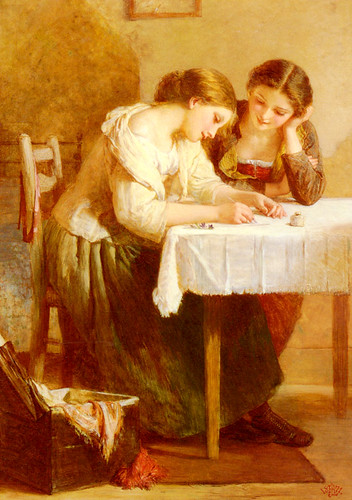
Verily I say unto you, Except ye be converted, and become as little children, ye shall not enter into the kingdom of heaven.~Matthew 18.3 I have learned so much from my children and I know I will continue to learn from them. So, "I need to make sure I'm a fast learner, because they won't always be around to hold my hand."
17 January 2013
Wrapping up week 2 Sonlight
23 March 2012
Education as a series of relationships

07 November 2011
Curriculum choices and the individuality of children
Those who tend to stick to the recipe probably like the security of doing what they're told to do. Someone has already figured this out so I don't have to can be a comforting thought. But sometimes the recipe just doesn't fit your situation. Maybe the person who created the recipe has a passion for hot and spicy, while your family prefers mildly spicy. Maybe the recipe says to bake at 450 for 15 minutes, but you know that your oven struggles to keep a constant heat at that high of a temperature.
So most cooks learn to make adjustments. They might reduce the amount of cayenne pepper or leave out the tabasco sauce. They might add more minutes onto the baking time. Whatever adjustments they make, they tweak the recipe to better fit their families and their situations.
Curriculum is like a Recipe
Curriculum is a lot like a recipe. Whoever writes the curriculum is setting forth what he prefers; what worked in his situation. But just because the author presents it a certain way doesn't mean you have to use it exactly as is.
Maybe a certain curriculum moves a little too quickly for your child; you can adjust it to a slower pace. Maybe a curriculum doesn't include enough hands-on activities for your tastes; you can add some. Maybe you like everything about the curriculum except one little part; leave it out. Maybe a particular recommended "ingredient" isn't available in your location; substitute something similar.
Just as people who create recipes are dealing with ingredients, not your family's taste preferences or your finicky oven, so people who write curriculum are dealing with the material, not with your unique child. It's impossible to write a curriculum that will address the specific needs of every single child. That's where you come in.
As the parent-teacher, your focus needs to be on educating your child as a person. In fact, that premise is the foundation on which Charlotte Mason built her whole philosophy.
The central thought, or rather body of though, upon which I found, is the somewhat obvious fact that the child is a person with all the possibilities and powers included in personality.
So don't expect a one-size-fits-all curriculum to suit each unique personality in your family; it won't. But that's the beauty of homeschooling; you can make adjustments. Any time!
You have permission. It's your family. It's your child. You know him better than any curriculum writer ever could.
Teach the child; don't just teach the curriculum. ~full article can be found at Simply Charlotte Mason
This is why I LOVE homeschooling. I have so many different types of learners, personalities, and temperaments that there is NO way I could possibly try a one size fits all approach. Truly each child is different and having the ability to pick and choose what fits each child is key in preparing them for their special and unique walk that they will have to walk in this life. Other wise it's kind of like pushing a square peg into a round whole. It just doesn't work and trying to force upon a child something that 'we think' is a one size fits all curriculum will eventually bring frustration, unhappiness, boredom, etc. for all involved.
01 July 2011
101 Reasons as to why I homeschool
10 April 2011
101 Reasons as to why I homeschool

18 March 2011
101 Reasons as to why I homeschool
05 March 2011
101 Reasons as to why I homeschool
Reason 83
"True Education is, in one sense, a spiritual process. It is the nurture of the soul. Education is the nurture of a spirit that is rational and moral, in which conscience is the regulative and imperative faculty. The proper purpose of conscience, even in this world, is moral. But God is the only Lord of the conscience; this soul is his miniature likeness. His will is the source of its obligations. Likeness to Him is its perfection, and religion is the science of the soul's relations to God. Let these statements be placed together, and the theological and educational processes appear so related that they cannot be separated.
It is for this reason that the common sense of mankind has always invoked the guidance of the minister of religion in the education of youth....Every line of true knowledge must find its completeness as it converges on God, just as every beam of daylight leads the eye to the sun." Robert Louis Dabney
Reason 84
"I am much afraid that the schools will prove the very gates of hell, unless they diligently labour in explaining the Holy Scriptures, and engraving them in the hearts of youth. I advise no one to place his child where the scriptures do not reign paramount. Every institution in which means are not unceasingly occupied with the Word of God must be corrupt." Martin Luther
Reason 85
"I can say that it is good and wise and judicious in parents to instruct their chidlren in the way. If they wish the word of the Lord upon the subject, I will give it to you and you may, any of you, write it down if you please. It is the will of the Lord our God that we teach our children the way of righteousness from the Holy Scriptures and there is no better method than for mothers to teach them at home, and in the Sunday Schools." Brigham Young
Reason 86
"As societies as a whole have decayed and lost their moral identity and so many homes are broken, the best hope is to turn greater attention and effort to the teaching of the next generation-our children. In order to do this, we must first reinforce the primary teachers of children. Chief among these are the parents and other family members, and the best environment should be in the home." James E. Faust
04 February 2011
101 Reasons as to why I homeschool

17 December 2010
101 Reasons as to why I homeschool
27 October 2010
101 Reasons as to why I homeschool

16 October 2010
101 Reasons as to why I homeschool


13 September 2010
101 reasons as to why I homeschool


26 August 2010
101 reasons as to why I homeschool
24 August 2010
101 Reasons as to why I homeschool


23 August 2010
101 reasons as to why I homeschool
22 August 2010
101 reasons as to why I homeschool

05 February 2009
But, What About Socialization????
Socialization: Homeschoolers Are in the Real World
Home School Legal Defense Association
For instance, public school children are confined to a classroom for at least 180 days each year with little opportunity to be exposed to the workplace or to go on field trips. The children are trapped with a group of children their own age with little chance to relate to children of other ages or adults. They learn in a vacuum where there are no absolute standards. They are given little to no responsibility, and everything is provided for them. The opportunity to pursue their interests and to apply their unique talents is stifled. Actions by public students rarely have consequences, as discipline is lax and passing from grade to grade is automatic. The students are not really prepared to operate in the home (family) or the workplace, which comprise a major part of the "real world" after graduation.
Homeschoolers, on the other hand, do not have the above problems. They are completely prepared for the "real world" of the workplace and the home. They relate regularly with adults and follow their examples rather than the examples of foolish peers. They learn based on "hands on" experiences and early apprenticeship training. In fact, the only "socialization" or aspect of the "real world" which they miss out on by not attending the public school is unhealthy peer pressure, crime, and immorality. Of course, the average homeschooler wisely learns about these things from afar instead of being personally involved in crime or immorality or perhaps from being a victim.
For full article click HERE